
Dealership delivery operations
The Hidden Cost of Delayed Vehicle Deliveries
Selling the vehicle is only part of the job.
For a dealership, another critical operational window begins the moment the customer says yes: the time between sold and delivered.
That period may last an hour, several hours, a day, or longer. During that time, sales, finance, vehicle prep, recon, registration, insurance, back office and management may all need to complete their part of the process.
When everything works, the customer arrives, signs what remains, takes delivery and drives away. When it does not, the dealership pays for the inefficiency.
Not always through one obvious expense. Instead, the cost appears across cash flow, employee productivity, customer wait time, financing delays, operational capacity and management attention.
That is why delayed vehicle deliveries should be viewed as more than a customer-service problem. They are an operational problem with financial consequences.
A Sold Vehicle Is Not Necessarily a Finished Deal
Once a customer agrees to purchase a vehicle, there may still be significant work left before the transaction is truly complete. A dealership may still be waiting for:
- lender approval
- required stipulations
- insurance verification
- registration documents
- title or payoff information
- vehicle preparation
- detailing or recon
- accessory installation
- finance availability
- customer documentation
- final delivery coordination
None of these situations is unusual. The problem begins when the dealership does not have one clear operational view of all of them — the job of dealership delivery software.
Sales may know when the customer is coming. Finance may know there is a funding issue. Recon may know the vehicle is not ready. Back office may be waiting on paperwork. Management may not discover the full situation until the customer is already on the way.
That uncertainty creates friction. And friction costs money.
Funding Delays Can Become a Cash-Flow Problem
A vehicle may be sold, but that does not necessarily mean the dealership has completed the financial side of the transaction.
If a deal cannot be funded because documentation, approvals, stipulations or another requirement is incomplete, cash conversion may be delayed. Depending on the circumstances, the dealership may also continue carrying inventory-related costs while employees spend additional time resolving the issue.
One delayed deal may not materially affect the store. But dealerships operate at volume. When the same type of delay happens repeatedly across dozens or hundreds of monthly deliveries, small inefficiencies begin to compound.
Management should therefore ask more than: “Did the deal eventually get funded?”
A better operational question is: “How long did it take us to get this deal from sold to completed, and what caused the delay?” That information creates an opportunity to improve the process instead of simply accepting the delay as normal — finance readiness is where most of that time hides.
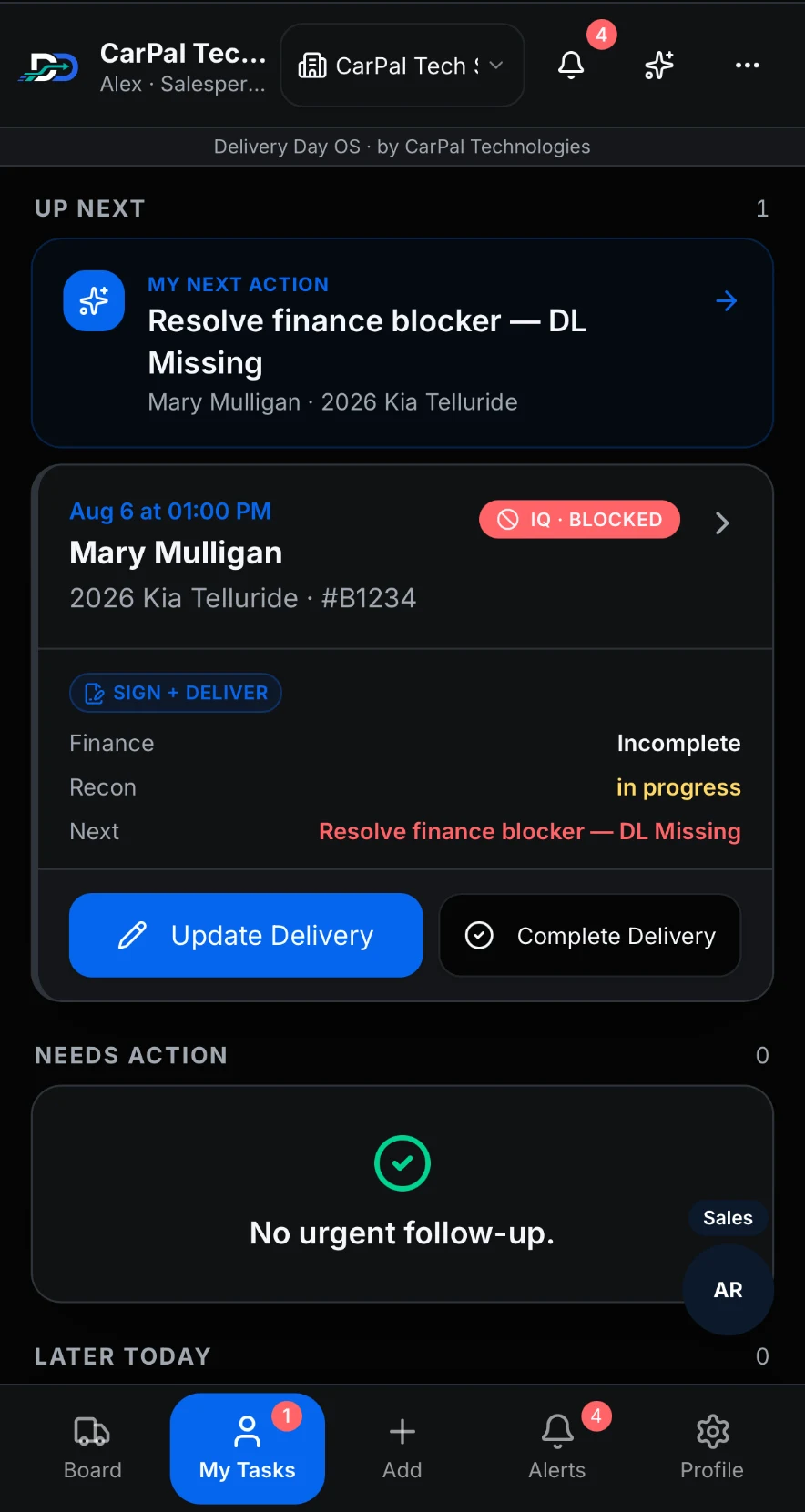
See Delivery Day OS in Action
Delivery Day OS gives dealerships one live operational view of the process between sold and delivered—helping sales, finance, vehicle prep, back office and management see what is ready, what is blocked and what requires attention.
Employee Interruptions Have a Real Cost
Some of the most expensive dealership inefficiencies do not appear neatly on a financial statement. Consider a common delivery-day scenario.
A salesperson wants to know whether the customer's vehicle is ready. They walk to vehicle prep. Vehicle prep stops working to answer the question. The salesperson then checks with finance. Finance stops working to provide an update. The customer changes their arrival time, so the salesperson finds a manager. The manager then needs to determine whether the store can accommodate the new delivery time. Perhaps someone also needs to call registration or verify insurance.
Each interaction may take only a few minutes. But those minutes multiply.
Across an entire dealership, the organization can spend significant employee time simply searching for the current status of work already in progress. That time could instead be spent:
- helping another customer
- preparing another vehicle
- completing another finance transaction
- resolving another blocker
- managing the sales floor
- increasing delivery capacity
Operational visibility therefore does more than make the dealership feel organized. A shared dealership delivery board gives productive time back to the store.
Recon and Vehicle Prep Delays Create Downstream Problems
Vehicle readiness is one of the clearest examples of how one department can affect the entire delivery process. If the vehicle is not prepared when expected:
- the salesperson has a problem
- the delivery schedule has a problem
- management may have a problem
- the customer may have a problem
The issue may not be that the vehicle-prep team is working too slowly. They may simply have competing priorities without enough visibility into which vehicle matters most right now.
A vehicle scheduled for tomorrow and a vehicle scheduled for delivery in 45 minutes should not necessarily carry the same operational priority. That is why recon coordination needs more than a task list. Readiness needs to be connected to time.
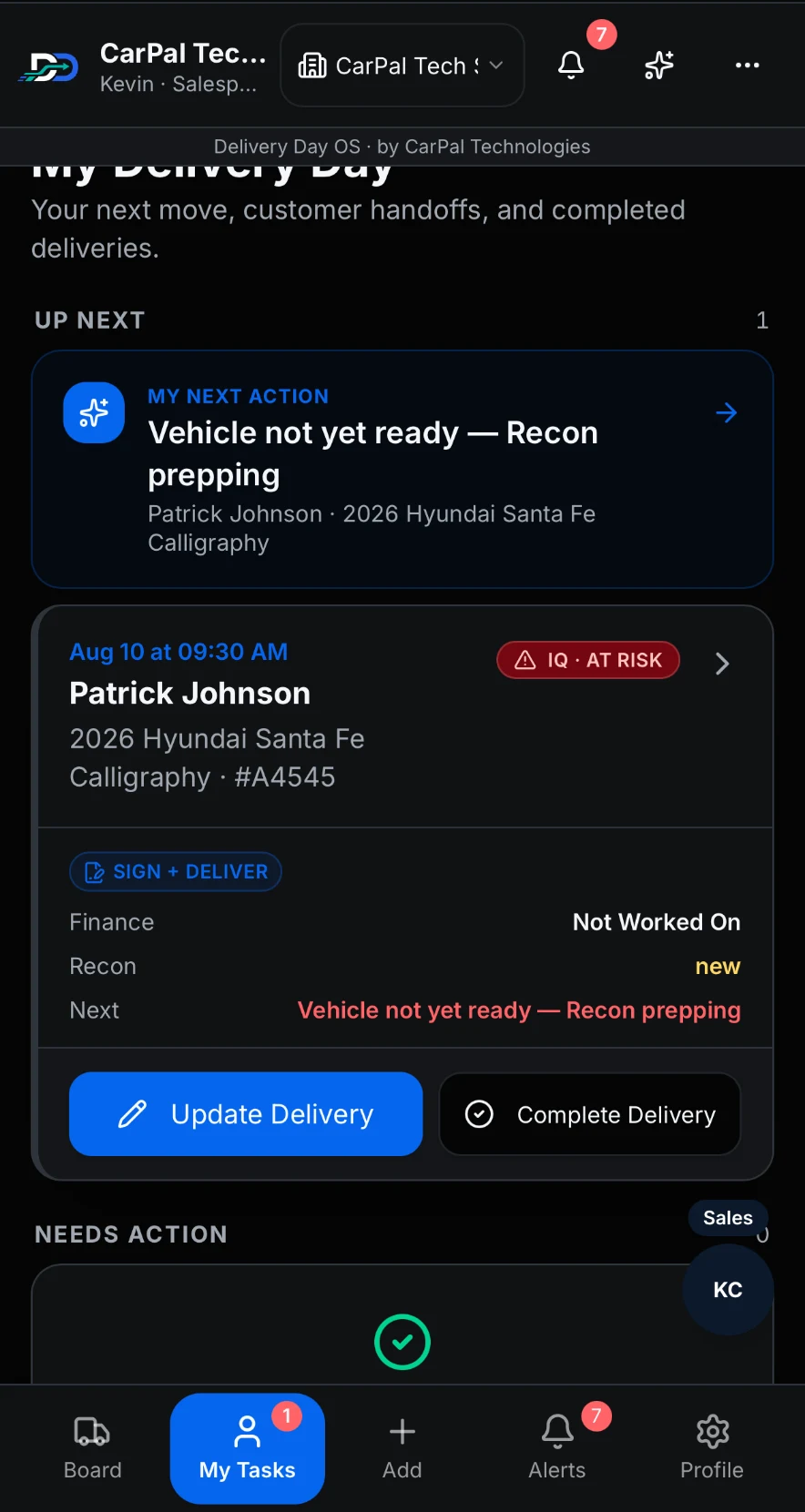
Readiness Has a Clock Attached to It
Consider two identical vehicles. Both are 80% ready.
The first customer is arriving at 5:00 PM and it is currently 10:00 AM. The second customer is arriving at 5:00 PM and it is currently 4:45 PM.
The readiness percentage may be identical. The operational risk is completely different.
This is why dealership delivery readiness should consider several variables together: readiness, timing, capacity, ownership and risk.
Knowing that a task is incomplete is useful. Knowing that the task is incomplete and the customer is arriving in 20 minutes is actionable. That distinction can help management intervene before an internal delay becomes a customer-facing problem.
Customer Wait Time Can Damage the Final Impression
A dealership may spend days or weeks earning a customer's business. The final delivery should reinforce that decision. Instead, customers sometimes arrive and discover:
- the vehicle is still being cleaned
- finance is not ready
- registration is incomplete
- nobody knew they had arrived
- the salesperson is searching for an update
- the delivery appointment was scheduled during an overloaded period
Even if the dealership ultimately completes the transaction, the customer experiences unnecessary friction during what should be one of the most exciting parts of the purchase.
That matters because the delivery is often the customer's final major interaction with the dealership before ownership begins. A smooth delivery can reinforce confidence. A chaotic one can undermine an otherwise excellent sales experience.
Delivery Capacity Matters
Dealerships frequently focus on sales capacity. How many leads can the store handle? How many appointments? How many salespeople? How many vehicles can the dealership sell this month?
But there is another question: how many vehicles can the dealership deliver efficiently at the same time?
A store can create unnecessary problems by scheduling more deliveries than finance, vehicle prep or management can realistically support during a particular window. For example, five customers arriving around the same time may create a finance bottleneck even if every vehicle is ready. Another afternoon might have sufficient finance capacity but too many vehicles waiting on prep.
Delivery capacity therefore changes throughout the day. Managers need visibility into both what is scheduled and whether the dealership is operationally prepared to execute it — which is exactly what vehicle delivery scheduling should account for.
Why Calendars and Spreadsheets Only Solve Part of the Problem
Many dealerships already have a process. That process may include:
- Google Calendar
- Outlook
- Google Sheets
- Excel
- whiteboards
- group text messages
- CRM notes
- DMS screens
- phone calls
- conversations across the showroom
These tools can all be useful. The issue is not that dealerships are using the wrong tools. The issue is that those tools frequently answer different questions.
A calendar can tell you when the customer is scheduled. A spreadsheet can tell you what someone last entered. A CRM can tell you about the customer and sales process. A DMS performs critical dealership transaction and accounting functions.
But management still needs an operational answer to a different question: can this delivery successfully happen when it is supposed to happen?
That requires information from multiple parts of the store to come together.
One Live Operational Truth
A modern dealership delivery process should allow the appropriate team members to immediately understand:
- when the customer is expected
- whether the vehicle is ready
- whether finance is ready
- what is blocking completion
- who owns the next action
- how much time remains
- which deliveries are becoming risky
- where capacity problems are developing
Instead of asking “What's going on with this delivery?” the organization should be able to see “Here's exactly what needs to happen next.” That is a fundamentally different operating model.
From Delivery Chaos to Operational Intelligence
The objective is not to add another complicated system to the dealership. It is to remove uncertainty from a workflow that already exists.
A dealership does not need software simply because software is available. Technology earns its place when it helps employees:
- communicate less manually
- identify problems sooner
- understand priorities faster
- reduce unnecessary interruptions
- execute more consistently
- protect the customer experience
- give management better operational visibility
That is the opportunity between sold and delivered. And it is the problem Delivery Day OS™ was built to address.
Delivery Day OS connects delivery scheduling, readiness, vehicle preparation, finance visibility, operational blockers and management oversight into one live dealership workflow.
Because the sale should not become harder after the customer says yes.
Delivery Day OS™
Ready by Design.
See the sold-to-delivered workflow in action
Enter your email and we'll send you a short demo of how Delivery Day OS helps dealerships coordinate delivery readiness in real time.
About the Author
Kevin Covington is the founder of Delivery Day OS and has more than a decade of experience working inside automotive retail. Delivery Day OS was developed around the operational challenges that occur between the moment a vehicle is sold and the moment the customer takes delivery.